
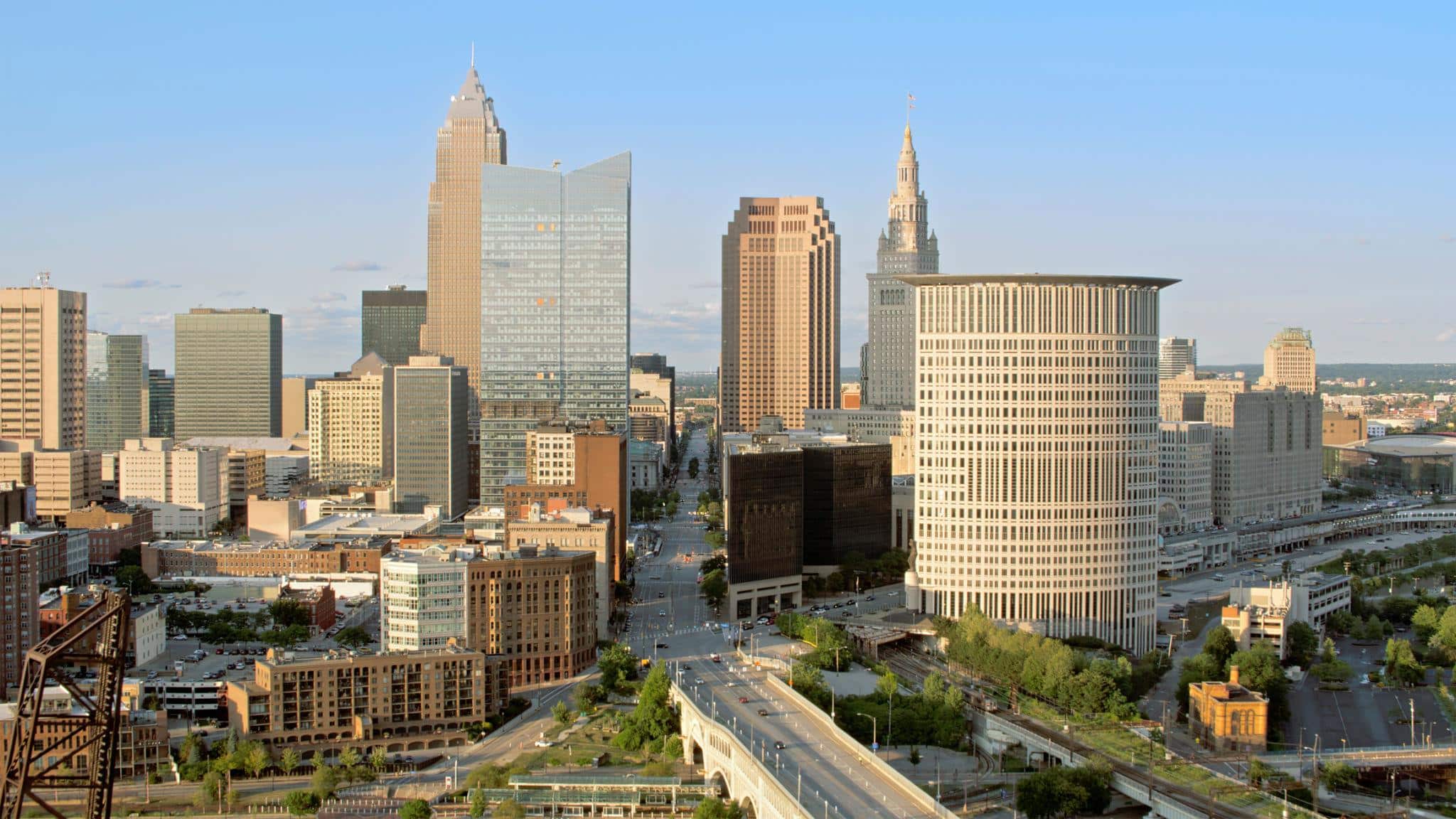
Cleveland’s economic story is often simplified into two chapters: rise and decline. Industrial boom. Rust Belt falloff. End of narrative.
That framing misses the most important part — what happened next.
Greater Cleveland did not disappear when manufacturing shifted. It recalibrated. It diversified. It invested in sectors that tend to be more durable than steel mills and shipping docks. And while that transformation didn’t generate splashy headlines, it quietly reshaped the region into something far more balanced.
Understanding this evolution helps explain why communities like Lakewood and Westlake remain stable, attractive, and economically active today.
Industrial Dominance
In the late 19th and early 20th centuries, Cleveland was a manufacturing giant. Its position on Lake Erie, combined with rail access and the Cuyahoga River, made it a logistical advantage for steel production, oil refining, and heavy industry.
By the early 1900s, Cleveland ranked among the largest cities in the United States. Industrialists built fortunes. Workers built neighborhoods. Dense housing developments, many of which still stand in Lakewood and inner-ring suburbs, were constructed to accommodate growing populations.
Industry shaped architecture. It shaped infrastructure. It shaped identity.
But heavy dependence on a single economic engine comes with risk.
Contraction and Adjustment
By the mid-to-late 20th century, global manufacturing shifts began to erode Cleveland’s industrial base. Factories closed. Shipping slowed. Population declined as residents moved outward or left the region altogether.
The phrase “Rust Belt” became shorthand for cities like Cleveland.
Yet even during contraction, key institutions remained strong. Healthcare systems expanded. Universities retained talent. Financial and service sectors began slowly filling gaps left by manufacturing losses.
What makes Cleveland’s transition noteworthy isn’t that it happened — many cities went through similar shifts — but that it unfolded gradually enough to allow for reinvestment rather than collapse.
That distinction matters.
Healthcare: The Stabilizing Force
The expansion of the Cleveland Clinic and University Hospitals became a cornerstone of the region’s economic stabilization.
Healthcare is not cyclical in the same way manufacturing can be. Demand is consistent. Research funding attracts talent. Medical campuses create secondary economic ecosystems — from biotech startups to hospitality and housing demand.
This sector now employs tens of thousands across Greater Cleveland and draws patients nationally and internationally.
Downtown Reinvention and Mixed-Use Development
Downtown Cleveland’s redevelopment represents another phase of evolution.
Former warehouse districts transformed into residential lofts. The Flats, once primarily industrial, reemerged as a mixed-use corridor blending entertainment, housing, and office space. Infrastructure improvements improved walkability and connectivity.
These shifts didn’t happen overnight. They were layered — public investment paired with private development.
The result is a downtown core that feels active without being overcrowded, accessible without being overwhelming.
That balance appeals to both young professionals and long-term residents.
West-Side Expansion: Lakewood and Westlake’s Role
While downtown reinvested, west-side communities evolved in parallel.
Lakewood retained its historic density and housing stock, appealing to renters, young professionals, and families who value proximity to the city core. Its established commercial corridors remained active even during broader economic transitions.
Westlake, by contrast, leaned into expansion. Developments like Crocker Park reshaped suburban retail and office space by blending walkability with commercial visibility. Corporate offices and medical facilities reinforced the suburb’s economic presence.
Together, Lakewood and Westlake illustrate two complementary strategies: preservation and expansion.
Both contribute to regional resilience.
As a company serving homeowners and commercial properties throughout these communities, we’ve watched that resilience play out street by street — historic duplexes maintained with care in Lakewood, modern office buildings rising steadily in Westlake.
Economic evolution isn’t abstract here. It’s visible.
Diversification Beyond Healthcare
Healthcare may anchor the region, but it’s not alone.
Logistics, advanced manufacturing, financial services, and a growing technology presence have diversified the economic base. Proximity to major highways and Lake Erie shipping lanes continues to support distribution networks.
Educational institutions feed skilled labor into local industries. Small businesses — particularly along west-side corridors — add entrepreneurial depth.
Cleveland today is not dependent on a single dominant sector. That diversity reduces risk.
Stability as a Competitive Advantage
Some cities chase rapid growth. Venture capital floods in. Real estate prices spike. Headlines celebrate acceleration.
Cleveland’s trajectory has been steadier. That steadiness may not generate national buzz, but it fosters predictable property markets and manageable commercial lease structures.
For homeowners and property managers in Lakewood and Westlake, that stability often translates into sustainable property values rather than volatile swings.
It’s a different kind of advantage — quieter, but meaningful.
Then vs. Now: A Broader Perspective
Early Cleveland built factories and shipping infrastructure. Modern Cleveland builds medical campuses, mixed-use developments, and technology partnerships.
The skyline has changed. The workforce has changed. But the core trait — adaptability — remains consistent.
Greater Cleveland’s economic story isn’t about dramatic reinvention. It’s about gradual refinement.
And in a national landscape that can feel unpredictable, refinement may prove more durable than reinvention.
Frequently Asked Questions
What was Cleveland’s main industry historically?
Steel production, oil refining, and manufacturing dominated Cleveland’s early economy.
What drives Cleveland’s economy today?
Healthcare, education, logistics, finance, and diversified commercial development now anchor the regional economy.
Is Cleveland’s economy stable?
Compared to more volatile growth cities, Cleveland’s diversified economic base contributes to steady long-term stability.
How have Lakewood and Westlake benefited from economic shifts?
Lakewood maintained strong residential demand due to proximity and character, while Westlake expanded commercial and mixed-use developments that strengthened suburban economic activity.
Greater Cleveland’s economic evolution is still unfolding. From steel mills to medical research centers, from industrial riverbanks to mixed-use waterfront districts, the region has reshaped itself without abandoning its foundation.
If you own residential or commercial property in Lakewood, Westlake, or surrounding west-side communities, maintaining that investment matters. Learn more about Paneless Window Cleaning and how we support properties across Greater Cleveland.